Monday, February 23, 2015

Race Across New Mexico, Stage 3

Stage 3 began slowly, with the first 3 miles at a 12 min/mile pace. After those first miles, though, my legs loosened up and I picked up the pace again.

This stage was very scenic and exciting!

First of all, we went through this town called "Pie Town." The pie tasted okay, but to tell you the truth, there is this place in Florence, Colorado that makes the best pie in the world (so you should go there!)


A couple miles later, I saw two animals cross the road, probably 300 meters up the road. They were very low to the ground, and a smaller size, so I knew they weren't mountain lions. They could have been, however, wolves! A lady had talked to us about wolves being in the area...the person in front of me was probably 5 minutes up the road, and the person behind me was 3 minutes behind, so I was all alone. Sort of unsettling, but I hoped my bright green jacket would frighten any wild animals away as I ran by.

Next, I passed over the continental divide! I thought it would be the highest point on the course, but it actually was about 300 feet lower than the highest point a couple miles down the road.


Next, I entered the Cibola National Forest. Spread out in New Mexico, this is also the forest that the Cedro Peak 45k and 45 Mile takes place in. The Cedro Peak 45k, which I ran in 2013, was very treacherous and awesome, and I was glad to be back in this National Forest.


At around 13.5 miles, we hit the highest point on the entire course from CA to DC, at 8128 feet. I was excited to see my altimeter hit 8000 feet, but didn't get a photo of the highest point:


Stage 3
Distance - 26.53
Time - 4:36:21
Pace - 10:25
Calories - 1955
Elevation Gain - 1119
Elevation Loss - 1273
HR Avg - 140
HR Max - 169
Minimum Elevation - 7259
Maximum Elevation - 8120

Totals (3 Stages):
Distance - 79.54
Time - 13:36:36
Pace - 10;16
Calories - 6306
Elevation Gain - 3132
Elevation Loss - 3245
HR Avg - 145
HR Max - 182
Minimum Elevation - 7024
Maximum Elevation - 7792

Race Across New Mexico, Stage 2


RANM, Stage 2 began near the town of Quemado, NM. I was feeling pretty good on this day, except for the fact that the camber of the road (the slope of the shoulder) aggravated my left leg. It seemed as if the slant was putting more impact on my left side, as well as trying to force the tibia (shin) to externally rotate more than it should.

Thus, I noticed that the pes anserine area was a bit sore. This is the spot on the inside bottom of the knee where three major muscles attach: the sartorius, gracilis, and semitendinosus.

I switched it up a bit and ran a lot of today's stage on the right side of the road. Usually, running on the right side is not recommended, but there is not much traffic out in this part of New Mexico, so it is didn't seem to be a problem.

Stage 2
Distance - 26.52
Time - 4:40:03
Pace - 10:34
Calories - 1974
Elevation Gain - 861
Elevation Loss - 1007
HR Avg - 139
HR Max - 195
Minimum Elevation - 6864
Maximum Elevation - 7625


Totals (2 Stages)
Distance - 53.01
Time - 9:00:15
Pace - 10:12
Calories - 4351
Elevation Gain - 2013
Elevation Loss - 1972
HR Avg - 147
HR Max - 188
Minimum Elevation - 6907
Maximum Elevation - 7628


Race Across New Mexico, Stage 1


The RANM began at the Arizona/New Mexico border on US Highway 60. Even though I was little bit nervous for the start of the event, I managed to sleep really good the night before the start.

The weather for Stage 1 was pretty good, but with all the sun beating down on the participants, it seemed almost too hot.

Stage 1
Distance - 26.49
Time - 4:20:12
Pace - 9:50 min/mile
Calories - 2377
Elevation Gain - 1152
Elevation Loss - 965
HR Avg - 155
HR Max - 181
Minimum Elevation - 6950
Maximum Elevation - 7631

Monday, February 9, 2015

The Taper

Hello!

With just a couple days before the New Mexico adventure begins, I am well into one of the best tapers I have had in my life. With marathon and triathlon training, the taper is never that fun, as you just lessen the training and get nervous to hit your goal mile-splits. I remember still having a ravenous appetite during my marathon tapers, but since I was only running half the miles that I usually did, I couldn't afford to eat that third steak, as Ron Swanson would say:


That kind of stuff is stressful during a taper, trying to keep that spice in the legs and trying not to gain those couple of pounds that would add 15 seconds to each mile.

With my taper for the Race Across New Mexico, I am feeling really good about all the training that has occurred up to this point. Last week, I finished my 2nd cycle of a "100 Mile Work Week" (running 100 miles Monday through Friday for two weeks, with the weekends off), and my legs felt incredible! I could get used to running 100 mile weeks, and the 14 hours of training each week really allows you to get some really good fresh air and enjoy the outdoors.

I thought about doing a 20 miler today, but in actuality, it probably would do nothing for preparing me to run 390 miles in 15 days. All of the base training I have is in there in my legs, and now I just need to take it easy and relax. If anything, I could use more mental preparation.  Speaking of which, I have been reading an excellent book by former Navy SEAL Commander Mark Divine entitled "The Way of the SEAL." In this book, Mark Divine gives a lot of exercises to help you focus your mind and complete your mission, whatever it may be. I would highly recommend this book! Most important to me so far have been the visualization and breathing exercises, and also defining what my purpose is.


***

During my most recent runs, I have been thinking a lot about how awesome it is to run. Some recent quotes I have really taken a liking to:

"It's not all about going faster. It's not all about winning races or doing well in races. It's about, you know, what running means to me."

This bit of wisdom was given by Rickey Gates, who won the Canadian Death Race in 2011. In a video I watched of him, he also talks about the idea of what you have. Many people want material things, a bigger house, a newer car. The triathlete wants a newer, full-carbon bike or a better power meter. Things things, yes they bring some sort of satisfaction, but they don't bring to you a realness or a substance to your soul. Rickey Gates speaks of life experiences, and how those experiences, those stories, are what really matter. It's not what you have...it's what you experience.

I want my experiences to be varied and wonderful, and I also want my experiences to make some kind of impact on others. This New Mexico excursion will be something that I will always remember. It will be a journey to find out something new about myself, but more importantly it is a journey that will have the possibility to affect others in magnificent ways.

Another amazing person, Bernd Heinrich, said this about running:

"Ideally you'd like to be a bird, but running is a close second."

Nothing could be more true. Nothing compares to being out there in nature, running from here to there, or maybe just running with no goal in mind. Running in new, unexplored place is very magical, and does in fact make you feel like a bird on the wind. Your mood is elated, just like a bird on the wind, ebbing and flowing with your thoughts, with what your senses take in: the feeling of the breeze upon you, the way the sun ducks behind high cirrus clouds, the undulations of the dirt and rocks beneath your feet. Once you get away from running for the sake of hitting specific mile splits, and once you can accept that it is even more amazing to run for the sake of running itself, it is at this instant that you truly begin to live.

So on your next run, try to take in your surroundings. Play with a dog through a fence. Pick up some weird pine cones or rocks. Run a new route that is really hilly and offers good views.

***

Well, this is enough for you to think about in this post. Check back soon for more updates on the preparation for the New Mexico trip!

Until then,

Run on!

Thursday, February 5, 2015

Good Bars to Snack On

Lately, I have been eating a variety of different little snack bars to help amp up the calories I am consuming during the day (also...I have been eating a lot of healthy fruit popsicle things!)

Anyway, here you will find a brief opinion of each bar. I "grade" the bars on a couple things:

Nutrition/Ingredients
Taste/Flavor
Use in physical activity
Cost

1 is the low score, and 5 means that they receive full points for the respective category!

:)

***

1. Bobo's Oat Bars

The first bars I will talk about are Bobo's Oat Bars. Straight out of Boulder, these oat bars are simply amazing, and even taste like a healthy dessert. Now, who doesn't want something like this to eat?


As you can see from the image below, one bar supplies you with 360 calories, so you can chomp one of these down in the morning if you want a medium amount of calories before you start your day. (I won't comment on the other facts, really...all the bars I am talking about are pretty healthy, so you can make up your mind to which one you like the best).


The ingredients are pretty simple and free of weird stuff. This bar appears to be a gluten-free bar (just because it was sent to me as a sample). I have nothing against gluten, though. The main sweetener in the bar is brown rice syrup, rather than sugar. Sugar is way down on the list, which is good...and even then, it is a non-refined cane sugar.


The plastic wrapper is very easy to open, and then you get this:


These bars hold together well, but crumble really easily and are not messy at all. Look at all this good stuff:


Here are the scores for the bar:

Nutrition/Ingredients = 4
Bobo's attempts to use organic ingredients and doesn't add any weird stuff.

Taste = 5
All of these bars taste like a healthy dessert, but not too sweet! Many flavors available!

Use in physical activity = 2
Some, like me, would like to say that they can digest anything on the run, but Bobo's are a bit harder to digest than Clif Bars. As an anytime snack, Bobo's are awesome...but on a run, these would not be good to eat. If you are going for a day-hike, then sure, take a bunch! The lower intensity will allow you to digest and absorb all the goodness of this calorie-dense snack. Also, the wrappers are very easy to open.

Cost = 3
~$1.25 per 180 calories. Priced a bit over $2 at my local health food store, these bars are in the average range for this kind of healthy, organic bar. Calorie-wise, you are paying a dollar for a "serving" size.

Total score: 14 of 20

***

2. Kind Bars

The next bar I like to eat are Kind Bars. Maybe a bit on the pricey side, these bars are very simple. They have a some kind of slogan about being able to pronounce all the ingredients.


Ranging around 200 calories per bar, you know you are only eating the good stuff. Nuts account for a lot of the calories.


And there it is, the simple ingredients that you can pronounce:


These bars can be sort of sticky. It is the vegetable glycerine and the non-GMO glucose that holds all the stuff together. The good thing about these two sweeteners is that there is a good mix of high and low GI (glycemic index) sugars present. The glucose will be absorbed quickly for a nice boost of energy, and the vegetable glycerine will take longer to be assimilated. And then you have stuff like raisins (mid GI) and the nuts (low GI), and also these little puffy things of "crisp rice" (a higher GI). So all in all, you get a whole bunch of variety. A whole bunch.


Nutrition/Ingredients = 5
Composing each Kind Bar are only the best and simplest ingredients.

Taste/Flavor = 5
With so many varieties, Kind Bars are way up on the list of tastiest bars!

Use in physical activity = 3
Kind bars could probably be used for a calorie kick while taking a break during a long run or long bike ride, as long as you are used to consuming nuts on the regular. With the good mix of low and high GI ingredients, your body will love these!

Cost = 2
~$1.50 per 200 calories. Costing you about around $1.50, these bars don't have too many calories for how much they cost. They do, however, have really good ingredients, but the bars are still sort of small. I would rather just eat some nuts and dried fruits...and that would be a lot cheaper. If you do buy these, buy in bulk...that will save you money and you could get these for about a buck each.

Total Score = 15 out of 20

***

3. PowerBar

Next, we move on to the classic energy bar, PowerBar. Considered to be the first "energy bar," I first associated PowerBars with the exciting late 1980s Ironman competitions.

I guess my favorite one is this peanut butter flavor:


All PowerBars are pretty calorie dense, with a lot of quick carbs to literally power you down the road, plus a good deal of protein. In this case, there is roughly a 5:1 ration of carbs to protein: With a glycemic index of 81, your body will just suck these bars up!


I don't have a picture of the ingredients, but the first ingredient is cane sugar...followed by sucrose. Hmm..not really too cool, to just be eating sugar? PowerBar also puts some maltodextrin in there (which has a GI of 105...this is the main source of carbohydrate in Hammer Perpetuem, the choice fuel of many endurance athletes).

When you try to open up a PowerBar, the wrapper sort of clings to the bar. The bar is sort of sticky:


Also, trying to bite into and chew a PowerBar can make your jaw hurt, especially if you are eating a couple PowerBars over a 5 hour run. The consistency of a PoweraBar is sort of like a softer, less chewy version of a Bit O' Honey:


Nutrition/Ingredients = 3
With cane sugar being the number one ingredient, PowerBar pales in comparison with Hammer products as a "healthy" endurance fuel. You still get in a lot of calories (240 per bar), but with it comes 44 grams of carbohydrates (a lot of it from the cane sugar).

Taste/Flavor = 3
PowerBars are quite palatable, but after a while the fake taste of these bars can get to you. Again, I must mention Hammer products, which have little taste and go down smooth. PowerBars come in a variety of flavors, so you can mix and match. My recommendations: Peanut Butter, of course, and also the Cookies and Cream, for a sweet little snack! Pair with an apple for a great afternoon pick-me-up!

Use in physical activity = 5
PowerBars were my original choice of fuel when I started training for ultramarathons in late 2006. Gels were great for up to a 3 hour race (my marathon pace), but after that 3 hour mark, I simply needed more calories and wanted something that was a little more like food rather than the thick "paste" category of gels.

One comment is that if it is below 40 degrees, trying to eat a PowerBar becomes quite difficult. The already firm consistency becomes even more like Bit O' Honey, and your jaw has to work at chewing the dang thing. When I used to do back-to-back long runs over a weekend, my jaw would actually hurt on Sunday (after eating 3 PowerBars the day before). On Monday, my jaw would make a clicking sound when I ate.

Also, if you are trying to take it a bit of calories every 10-20 minutes, PowerBars can be quite difficult to use. You can try cutting them into small pieces (usually I cut a 240 calorie bar into six 40 calorie "bites" that I take in every 15 minutes over 90 minutes...an average of 160 calories an hour), but then you have to deal with these sticky things. Also, the wrapper can get caught into the stickiness of the bar, and then you have to fish out bits of wrapper. Near the end of a 30 mile run when your mood begins to plummet, these can be quite frustrating and can make you cuss. And, also, if you leave the bar intact and just bit off a piece every 15 minutes, then your saliva gets on the bar and then you have this doubly sticky thing. So...I would use these only if the weather is over 50 degrees.

Cost = 5
~$1.00 per 240 calories. Retailing at basically a buck a bar, PowerBars are a steal! I usually buy a box of 6 and let that box last a while. Sometimes I take them on runs, or just eat them as snacks or as a quick, calorie-dense breakfast. The cheap cost could reflect the lower quality of ingredients, but if you eat them sparingly, PowerBars can get the job done. Also, since they are so cheap, why not stash a bar here and there (like keep some in your car's glovebox, or in your gym bag, or at your desk). Emergency snacks are very important to have, and PowerBars are much better for you than a $1.00 bag of chips.

Total Score = 16 out of 20

***

4. Clif Bars

Similar to a PowerBars, sort of, are Clif Bars. A bit more hefty than the sticky and slim PowerBars, Clif Bars are awesome because they were made by this dude who sounds like a fun guy. He used to live in a garage with a bike and two trumpets when he started playing around with making energy bars, and that is pretty kick ass.

The flavors are many, but I really enjoy the Peanut Butter Crunch, and also this new one that came out about a year ago called Coconut Chocolate Chip. There is also a Christmasy-type one that has mint and chocolate, and maybe peppermint.

Crunch Peanut Butter, for those times when you are clambering up some rocks (or hiking, or running):


Made with organic oats, Clif Bar is trying to choose quality ingredients. At 250 calories per bar, most Clif Bars average around 40 grams of carbs, and 10 grams of protein. This 4:1 ratio is ideal for those long, steady workouts or hikes:


The wrapper is simple to open, and out comes a magnificent piece of food. You can see the oats and the peanut butter in this particular bar (yum!):


Very easy to break or chew, Clif Bars have a consistent composition of yumminess. They are only a tad sticky, and you have to give a bit of effort to chew and swallow (Bobo's Oat Bars are much cleaner to consume).


Nutrition/Ingredients = 4
Sweetened with organic brown rice syrup and using organic grains, Clif Bars are definitely good for your body. There are also a ton of added vitamins and minerals, so you know your body will love them!

Taste/Flavor = 4
I have liked every Clif Bar that I have tried. Of course, I am not too particular, and I appreciate the goodness and energy these bars give to my body, so of course they will taste good to me :)

Use in physical activity = 3
I would say that these are a bit better than Bobo's Oat Bars during a run or bike. Clif Bars are hefty and will not break apart on you. They can be smashed at the bottom of a bag, but you can simply open it up and eat it. I would imagine that Bobo's Oat Bars would crumble all over the place if they got smashed. You still have to chew Clif Bars quite a bit, so they are not as good as a gel or Hammer drink, but overall, Clif Bars will get you from Point A to Point B! The wrapper is also very easy to open, and you can wrap half of the bar back up and save for later without any mess.

Cost = 5

~$1.00 per 250 calories. Averaging a dollar each, Clif Bars are actually more cheaper than PowerBars (in terms of calorie content). They are also a lot more healthier than PowerBars, although Clif Bars are not the best choice for more intense rides and runs because they take more effort to digest. Buy these bars in bulk! A great snack for anytime!

Total score = 16 out of 20

***

5. Bear Valley Bars

The last bars I will talk about are more like small meals. Bear Valley Bars are made somewhere in California. There are a couple different options, with names like "Meal Pack" or "Pemmican" (the funny thing is that the "Pemmican" bars have no meat...they are vegetarian pemmican, I guess!) I prefer the Fruit and Nut bars, but there are also Carob Cacao, Coconut Almond, and Sesame Lemon options.


Packing 420 calories into one bar, Bear Valley Bars are a good choice if you want a lot of calories in a small package. There is roughly a 4:1 ration of carbs to protein:


The ingredients are pretty straight forward and healthy:


For me, the wrapper is very difficult to get off! There is no little perforated tab or a little slit to help make things easier. Either use a pair of scissors or a knife to open, or just maul it open with your bare hands. Once you get the bar out, it looks pretty basic. In this particular bar, there are fruit and nuts dotting the bar:


Very easy to break apart, Bear Valley bars maintain their shape, but can crumble a bit:


Nutrition/Ingredients = 5 
With only a couple ingredients used, Bear Valley bars are definitely nutritious. For those of you wanting a "complete protein," this bar satisfies what you are looking for. There are tons of amino acids and vitamins in Bear Valley bars, and the pieces of nuts and fruit are awesome! These bars also contain milk, which seems to limit them to hiking and general snacking, rather than a good choice for actual running and biking workouts.


Taste/Flavor = 4
The one thing about the malt syrup is that you need to really like the taste for these bars to work for you. If you are going to use these bars for a long run, then you will have to eat a malty thing, which is never too appetizing for me after 3 hours of running.

Use in physical activity = 2
With so many calories and being harder to digest, Bear Valley bars are best for snacking or hiking. Definitely takes a lot of work to chew and digest!

Cost = 5 
$1.25 per 420 calories. I buy these bars by the box (12 in a box), and therefore get a 10% bulk discount at the local health food store. With so many healthy calories for so cheap, these are definitely great to buy and eat!

Total score = 16 out of 20

***

Final Scores:


Bobo's Oat Bars = 14 out of 20
Kind Bars = 15 out of 20
PowerBar = 16 out of 20
Clif Bar = 16 out of 20
Bear Valley Bars = 16 out of 20

Based on the scores I assigned, it appears that PowerBars, Clif Bars, and Bear Valley Bars all come in with 16 out of 20 possible points. PowerBars are up there just because of the price; they are not the healthiest choice. Clif Bars are great for anytime, even on slow runs. Bear Valley Bars seem to be the most cost-efficient snack, but are limited to snacking and low-intensity hikes. The other two bars, Bobo's and Kind Bars, are great for snacks here and there, but are not the best choice for physical activity.

Well, tell me what you think of this, and what are your favorite bars to eat?

Until next,

Run on!

Friday, January 30, 2015

The 100 Mile "Workweek"

Hello!

Since I last wrote, things have been pretty busy. I have been figuring out the logistics for the New Mexico trip, finishing up some applications to schools for next fall, and busting out a "100 Mile Workweek." What this means is basically how it sounds: from Monday to Friday (today), I managed to put in 100 miles of running!

This is only the second time I have put in 100 miles in a week, the last being back in 2008, probably, when Ben Harden and I decided that we needed to throw down 100 miles in a week. I think we took 7 days to complete the 100 miles, and I remember that I was fatigued and had sluggish legs towards the end.

But this time around, I felt great the entire time, even though I smushed the 100 miles into 5 days. Trying to think of why this might be, I don't really know. I put in 69 miles in the New Balance Minimus shoes, so if haters say that minimal shoes don't have enough protection and make your legs tired, they don't have anything to base this on :) 16 miles were in the new Altra Superior shoes (see the last post). I thought that I would love these shoes, but they ended up being a flop. They literally make a flopping sound as I run, something about the structure of the sole, probably. Even when I was on the dirt and gravel, the flopping sound was still there and became annoying. It also made me think that there was something wrong with my running gait, even though there is definitely nothing wrong about it. Another thing about the shoe was that it dug into the Achilles tendon really bad. It's as if they made this shoe for people who have shins that are not perpendicular to the ground, but who lean forward at a 10 degree slant. The place where the back of the heel is supposed to make contact with the shoe is way open, like a half centimeter of space sits between it.

On the other hand, the 15 miles I put in with the Altra Paradigm were pretty good, but sort of weird. It is nice to have all the cushion and what not, but I don't really like how high you are off the ground. Any feel you have for the ground is eliminated; I like to run over rugged ground and feel the difference. I like to feel how gravel feels different from grass, or weeds, or rocks. With the Altra Paradigm, you can't tell any difference between any surface, and I find this to be quite strange. Regardless, the Paradigm will come in handy when I run across New Mexico on those days where I am feeling like a sissy and want to be coddled.

Anyway, here is a breakdown of the miles I put in during the past five-day "workweek:"

Monday: 20 miles in 2:52:20 (8:37 pace)

Tuesday: AM- 10 miles in 1:26:53 (8:41 pace), PM- 6 miles 52:22 (8:44 pace)

Wednesday: AM- 10 miles in 1:28:02 (8:48 pace), PM- 5 miles in 39:09 (7:50 pace), then 5 miles on the treadmill in 45:00 (9:00 pace)

Thursday: AM- 10 miles in 1:25:13 (8:31 pace), PM- 10 miles in 1:23:48 (8:22 pace)

Friday: AM- 15 miles in 2:10:28 (8:42 pace), PM- 9 miles in 1:11:59 (8:00 pace)


According to my Garmin, this 100 miles used up about 11,600 calories...and believe me, I made sure to consume enough food during the day (and a lot of snacks) in order to not be deficient in calories. So, based on the fact that I probably eat 2,000 calories a day x 5 days = 10,000 calories, I got to eat over 20,000 calories this week. That is a lot!

The total time for the 100 miles was 14 hours and 15 minutes (8:33 pace). So, not really too time consuming, if you think about it. It would be an average of 2 hours and 51 minutes a day. Think of all the time people spend watching TV or just jacking around each day. There is no reason that everyone can't get in a simple 30 minutes each day. That would total 3 hours and 30 minutes a week. Come on, let's get everyone motivated to get moving :)

On the other hand, this puts things more into perspective about elite marathoners and ultramarathoners. Those who bust out 100-140 miles a week regularly at a much faster pace are ridiculous! Anton Krupicka used to run around 200 miles a week! I am planning to do another 5-day cycle after a day off, but maintaining 100+ miles a week is hard work!

Another interesting thing to note: 90% of the time I use a 9:1 ration of running to walking. On most runs, even today's run of 9 miles at an average of 8:00, I take a 1-minute walking break every 9 minutes. Especially on long runs, I think this method is great for most people to follow! There is nothing wrong with walking, ever, and those runners who are gung-ho about running the entire time need to chill out. I qualified for the Boston Marathon a couple times even though I threw in some walking breaks in all of these qualifying marathons (in one, I HAD to walk because my legs were cramping up...I still slipped under 3 hours on this one, though, so the walking was more than acceptable). Especially in ultras, people are going to be walking. In the Badwater Marathon, 135 miles across Death Valley and half way up the 14,000 feet of Mt. Whitney, pretty much everyone ENTIRELY walks the last 8 miles (it IS up a mountain, though, after 127 miles of running through the hottest part of the US...so this might be the only way to get up there in the first place).

And, if you were wondering, there have been a couple beers thrown in there. Many studies have shown the positive effects of beer, like one that concluded that having a beer after a run actually opens stuff up in the body to allow for better absorption of the adequate fluid you will drink after drinking the beer! I'll drink to that! HERE is another little snippet of why you should drink beer! Cheers!

Well, that is about all for now...this weekend, look out for a small post about a couple of my favorite snacks: Kind Bars, Clif Bars, PowerBars, Bear Valley Bars, and my recent discovery, Bobo's Oat Bars from Boulder, CO!

Monday, January 26, 2015

New Altra Shoes!

Hello!

It has been quite a long time since I have last posted an update. My preparations for the Race Across New Mexico are going good, both in training and in planning the trip. I have been getting in a lot of good miles, and the weather here in Southern Colorado has been above 20 degrees (usually getting up to 50 during the day). I remember training for the Brew to Brew 44 Miler (Kansas City to Lawrence) in the winter of 2008-2009, putting in a lot of long runs in the cloudy and snowy plains of central Nebraska. In some ways, it seems like I was a lot more hardcore back then...just sipping Gatorade and eating PowerBars and busting out 30+ mile runs alone on the grid-like gravel roads surrounding my hometown. Now, I think that I need to consume state-of-the-art supplements, like those by Hammer Nutrition. Yes, it is nice to use one of their best products, Perpetuem, on a long run or bike, and it makes it entirely feasible to consume only liquid calories. But I look back on those early ultrarunning days with awe. All I needed was a pair of Nike Pegasus and a pair of shorts...although now, it seems that Nike does not make products like they used to. It seems like the Nike Free line up changed things, and now all of their shoes are sort of overpriced and not even that good!

This post is supposed to be about some new shoes that just arrived today! But first, here is a little history of my shoes:

From 2004-2011, I basically just ran in the Nike Pegasus. For my first ultra in 2007, I wore this awesome shoe by Nike called the Kyotee. Two months later, I didn't have any fresh Pegasus around, so I actually wore the Kyotee at the Boston Marathon. It was a light trail running shoe that wasn't too rugged, so it worked equally well on a single-track trail or wet, cold pavement (as it was at Boston 2007). I also ran in the North Face Fireroad for a bit.

In 2012, I switched it up to the New Balance 890. This was the time when the Pegasus was getting ridiculous and expensive and not really a performance shoe, in my opinion. The New Balance 890 worked great for me from 2012-2014. I first was drawn to it because of it's light weight (9 oz or so) and because it had a lower heel-to-toe drop (8mm compared to 12mm of most shoes). I also explored the New Balance Minimus Series, with the New Balance 1010 trail shoe (and also some other random Minimus road shoe). The 1010 worked perfectly for a trail marathon last summer, except that the gnarly trail frayed part of the fabric on the toes. Since then, the shoe has continued to deteriorate, even though it probably only has about 200 miles on it.

Anyway, I first discovered Altra shoes last May while looking for a low drop shoe. I ordered a pair called The Torin and loved them! I ordered a second pair and rotated these two shoes...until the first pair went straight to hell and, I think, contributed to the straining of my left soleus last October :( For such an expensive shoe, Altras seem to not really be that durable. Priced just a bit more, Hoka One One shoes are purported to last twice the miles of a regular shoe, but lack a foot-shaped design. Altra shoes look like a foot, and therefore allow your toes to splay out. Below is the same foot in an Altra shoe compared to a traditional running shoe:

More than anything, I appreciate Altra shoes for having this foot-shaped design. And since I usually wear zero-drop footwear such as XeroShoes in the summer, and Bearpaw in the winter, I want to make the same choice with my running shoes.

So, here are some images of the fun that happened tonight!

This is the box that arrived via UPS at like 6:30 pm or something...such a late delivery, and such a great surprise!


For a runner, this is probably the best site one can behold, aside from seeing the finish line at a tough ultra:


From left to right: Altra Paradigm, Superior 1.5, and the Repetition:


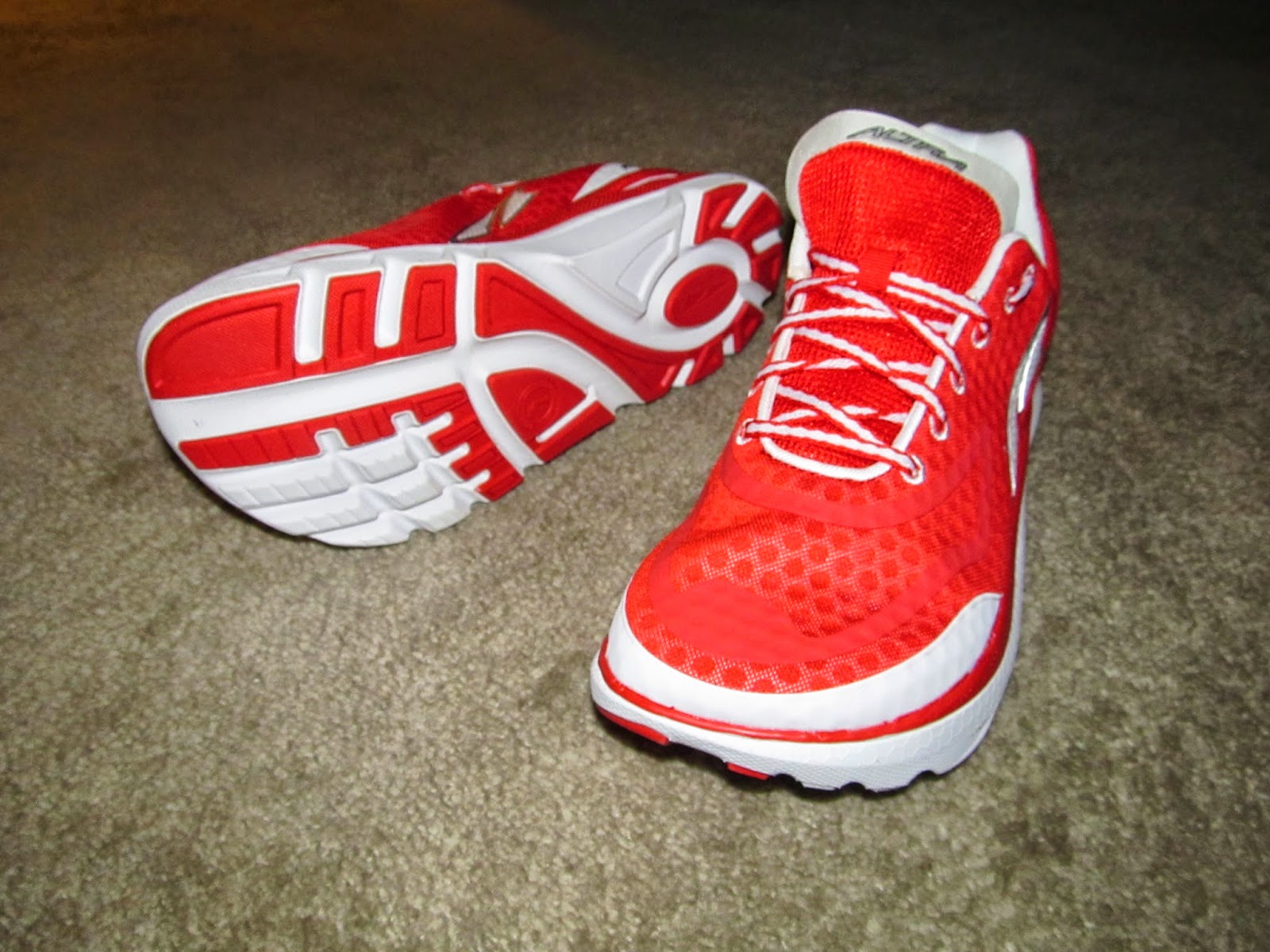
Right away, I can tell that the Superiors are going to be my favorite. They sit very low to the ground, and have this durable-looking (but not too rugged) outsole. To me, these seem like a more luxurious version of the New Balance 1010 trail shoe:


The Paradigms seem to be taking on the appearance of Hoka One One shoes. With a stack height of three inches (so it seems), these ones will be great for when my feet are feeling beat up. I would not feel comfortable with these on any trail or rugged terrain, as these shoes will break your ankles if you step wrong. But for the roads, they will be perfect:


Hmm...the Repetition shoes are interesting. They are a more of a stability shoe, with this firm wedge of rubber right underneath the arch to prevent over-pronation. For some reason I thought that a stability shoe could help in the 390 miles in 16 days across New Mexico, but trying on a stability shoe was jarring to my body after running in neutral shoes forever and the Minimus shoes as of late (I have only had two stability shoes, ever...and I only got them because they were on sale!). I do appreciate the design of these shoes, and heavier runners with low arches who severely over-pronate would benefit from this shoe. Also, Altra designed these shoes with a 4mm tilt from the medial to lateral side of the shoe to assist with motion control. A very radical idea, but this would simply mess up my legs and body if I ran in them...so, I will be sending them back!


Lastly, here are some images from my two pairs of Torins...they are pretty beat up, and seem to be unwearable for running now, especially since I think that the degradation of the blue pair caused my soleus strain.


You can sort of see here on the bottoms of the shoe, the construction is lacking. The grey part is a foam-type material which started to be eaten away by the pavement. The blue rubber is probably about as durable as any other shoe, but the combination of the rubber and foam would make this shoe more fitting for a very smooth gravel trail, or grass. Even a treadmill would eat it up.


Well, that is my nerd-out for now. Be on the lookout for more posts as the New Mexico trip nears! :)

Until then,

Run on!